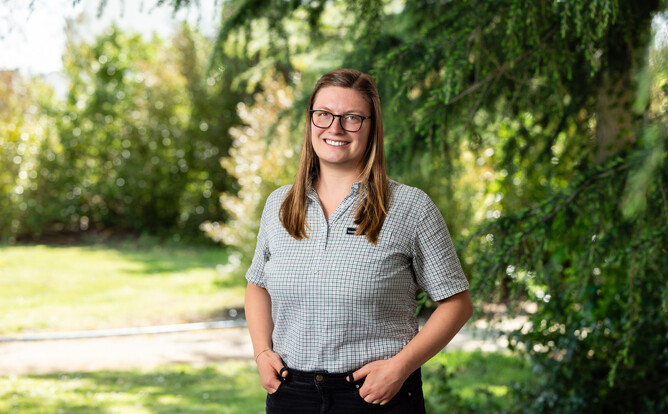
Isabel Schmahl – the 2025 FarmIQ Systems Emerging Rural Professional of the Year – grew up in Germany, followed by stints in Turkey and Russia, before moving to New Zealand almost 10 years ago.
What was originally meant to be a year of travel down under turned into many more, after Isabel worked on different farms across the country, then started working on a sheep and beef farm in Geraldine and fell in love with New Zealand agriculture and farming.
“I'm pretty much from a city background, but you don't know what you're missing out on!” smiles Isabel.
Isabel studied a Bachelor of Agriculture at Lincoln University, taking a wide variety of papers covering plants, soils, animal science, farm systems and genetics. One summer internship saw her study deer farm systems and genetics with AgResearch. After graduating, she spent several years on Pāmu farms as a farm technician.
She has fully embraced the Kiwi rural life, now living on a sheep and beef station in Te Anau with her partner. As well as being actively involved with her local dog trial club, she is treasurer for the Young Farmers Club and is on the steering committee of the Otago/Southland branch of the Institute of Rural Professionals.
“It's really satisfying – you learn so much from people and especially in the rural communities I feel community involvement and engagement are so important to keep things going, otherwise it just wouldn't happen,” says Isabel.
All this community activity is in addition to her full-time role as an Agri Manager for Ravensdown, where she looks after the northern Southland area.
“I really enjoy the variety I have in that role. I've got a mix of sheep and beef, dairy as well as arable clients,” says Isabel.
“Ranging from family farms to larger cooperatives, I feel quite privileged to support these farms with nutrient management and fertiliser advice, as well as a little bit of agronomy, environmental and compliance advice; the variety and learning in this role is what I really enjoy.”
Accolades abound
The FarmIQ Systems Emerging Rural Professional of the Year Award was one of three awards that Isabel won this year (she was also named the Ravensdown Rookie of the Year and Cooperative Business NZ Emerging Leader of the Year!) and she said it has been extremely humbling to receive the honour, especially because of how well-recognised it is in the sector.
“Winning the award has also given me a lot of encouragement that I'm on the right track and it has been inspiring and motivating me to continue making a positive impact on our ag sector.”
Isabel has appreciated the networks and connections that have arisen thanks to the award and the various opportunities it has led to, and she will be using her prize money on a new opportunity: the Kellogg Rural Leadership Programme.
She is hoping to start in the July 2026 cohort, and is excited to learn from leading industry professionals, connect with passionate peers and advance her personal and professional leadership development.
“I wanted to say thank you to the award sponsor FarmIQ and the Institute of Rural Professionals for the award…a massive thank you to my employer Ravensdown as well as my previous employer Pāmu, and Lincoln University for all the personal and professional opportunities too.”
It shows just how small and interconnected the New Zealand ag industry is – Isabel used FARMAX and FarmIQ while working as a farm technician, recognising the value the two tools offered farmers, and she’s been a member of the Rural Institute for a number of years, valuing the education and development options it offers.
“I love how the ag industry here is so small and so connected, and everyone's there to help out and share knowledge. The collaboration that happens – I think that's really what makes us so special…I'm really proud to be part of the New Zealand farming industry.”
"Winning the award has also given me a lot of encouragement that I'm on the right track and it has been inspiring and motivating me to continue making a positive impact on our ag sector."
- Isabel Schmahl, Ravensdown
Bridging the gap between policy and practice
Isabel wholeheartedly believes in the value that rural professionals provide, especially how they collect and disseminate information to farmers, colleagues and throughout the wider sector.
“There's a lot of skills like combining science and technical knowledge with the practical outputs and advice, as well as staying up to date on what's happening in our ag sector, talking to subject matter experts, bringing knowledge and experience across different parts of the industry,” Isabel explains.
“Rural professionals are crucial to helping advise and steer our ag industry in the right direction. Combing the professional knowledge and awareness with practical experience and how this can be rolled out and adapted to farmers…I think it's quite valuable bridging that gap between policy decision making and practical implementation on farm.”
She acknowledges that farmers are expected to be experts on so many different things, and that rural professionals are in the ideal position to support them by way of breadth and depth of their knowledge: rural professionals can act as the bridge between government policies and actual on-farm actions.
Isabel is certain that while the industry is ending 2025 on a generally positive note, there are still plenty of challenges ahead – challenges though, that can be tackled carefully and successfully.
“Environmental sustainability, rising input costs and international consumer pressures are massive challenges for next year and also going forward – staying profitable and productive while also being environmentally sustainable is key for our sector,” says Isabel.
“I also think continuous investment in science is crucial to help find different ways of manipulating production and its impact on the environment, for example, through efficient animal genetics breeding for low methane emitting livestock or farming with virtual fencing. “
“Embracing and using evolving science and technology advancements are all part of ensuring our point of difference in the international agricultural sector – we are wanting to produce the high-quality products for high-paying markets, so I think we need to be leading in that field.”