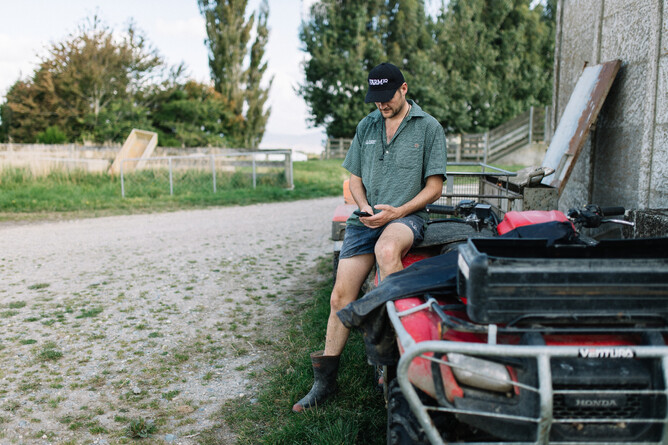
Head of Sales and Marketing, Russell MacKay, has a fifth-generation family sheep and beef farm near Queenstown. Here's his farming update as we round out 2025.
Pollen drifts in clouds, so thick,
Dust turns snot brown, how sick sick.
Tractors rumble through dark, never still,
Irrigators sprinkle pasture at will.
Summer conditions have set in early in most of the country. The north of the South Island is destocking, with animals being sent to Otago and Southland. This is the usual course of action, but that has not been the case in the past two years; we were selling store lambs in Southland to be finished in Marlborough – it was completely backwards.
Otago and Southland had some dry pockets which have recently been topped up, while there were areas too wet to get the tractor on the ground. There is feed-a-plenty down here now. Tailing percentages have been consistently over 150% but lambs were doing poorly due to a lack of vitamin D. They have since done well post tailing.
There was a mongrel of a storm in late October, and generators became more valuable than gold. Our farm had no power for over a week. For the last couple of generations, we have kept our firewood under a huge macrocarpa tree. Said tree snapped in half and fell on the firewood pile and crushed the wood splitter, talk about irony! I now have enough firewood for the next couple of generations. It was worse for dairy farmers who were desperate to get cows milked without dumping the income out of the vat. The Rural Support Trust tells me there is still assistance available for farmers trying to tidy up damage.
The North Island has become hot fast. Nearly the entire island looked desperately dry come late November. In early December, most parts received healthy, steady rain except for Hawkes Bay who are still doing a rain dance. The first half of December has been stinking hot, with conditions being more akin to mid-February than early summer. Stock are doing well but are starting to melt a bit, and fly strike is becoming an issue.
Lamb shearing has been done already, but even so the flies are in force; many farmers are dipping before Christmas as a result. Facial eczema is also showing its effects earlier than usual. Overall, the farmers I have talked to are concerned about a dry summer despite recent rain meaning they should be fine to the new year. Most are expecting a hot and dry one and are therefore selling stock at lighter than usual weights.
2025 at a glance
Although no year is the same, this year feels like it has been a particularly weird year for farming across the country. Here a few instances:
Weather: It seems like every couple of months, a region has experienced a 'once in 50 year weather event' (At what stage do we re-calibrate and say that since this has happened three times in 15 years, it is therefore now a 5 year weather event?).
Politics of farming: Rightly or wrongly, the farming sector has been on the 6 o'clock news a lot this year when it comes to anything politics related. RMA reform, carbon farming, solar/wind farms, revisiting GHG targets, trade agreements, wilding pines, what to do with our biggest farm (Molesworth), government owned asset sell down, Uncle Winnie weighing in on Fonterra and Alliance shareholder decisions, overseas investment ya-de-ya-de-ya.
Farm gate prices and expenses: Prices have been extremely strong overall for pastoral farming. Expenses have increased but not as much comparatively. Interest rates have jumped around a bit, but the general trend has been reducing.
Capital moving hands: Within my lifetime, I don't think capital has moved hands more so than this year. Dawn Meats took a stake in Alliance, Open Country did the same with Mataura Valley + Miraka, and the sell down of Fonterra assets is looking likely to put $2 a share into farmers pockets early next year. Compared to previous years, capital is being passed around like chip and dip!
What to do with the $: Referring to point 3 and part of point 4, what the hell are farmers going to do with the cash injection? Some great work was done by BakerAg surveying Fonterra farms. High milk price + low interest rates + cash injection + stagnant land prices usually means further investment into the industry, e.g. buy another farm, but that is not the case. Further debt reduction was top of the pile (76%). This would put farmers in a better position to buy land later, but it may not be realised for some time. For sheep farms, farmers I have talked to have said debt reduction is also top priority and putting some capital fertiliser on in places that were lacking in previous tougher years. Banks are almost begging farmers to take on some debt. A heap of principle has been repaid over the past couple of years with more to come.
So, what will 2026 bring? I've quit guessing. I think that most people who say they know what will happen are either lying or naïve. By nature, farmers are long term thinkers. It comes with working with the seasons and having the following generations in mind. But you can only control what you can control, so I'll focus on those things.
There are some jobs on farm that bode well with good thinking time, like getting the cows in for milking and tractor work. But sometimes you really need to take a step back and get off farm for some perspective. I hope you all mange to do this yourselves over the Christmas break with your loved ones.
All the best for 2026, I'll see you there.